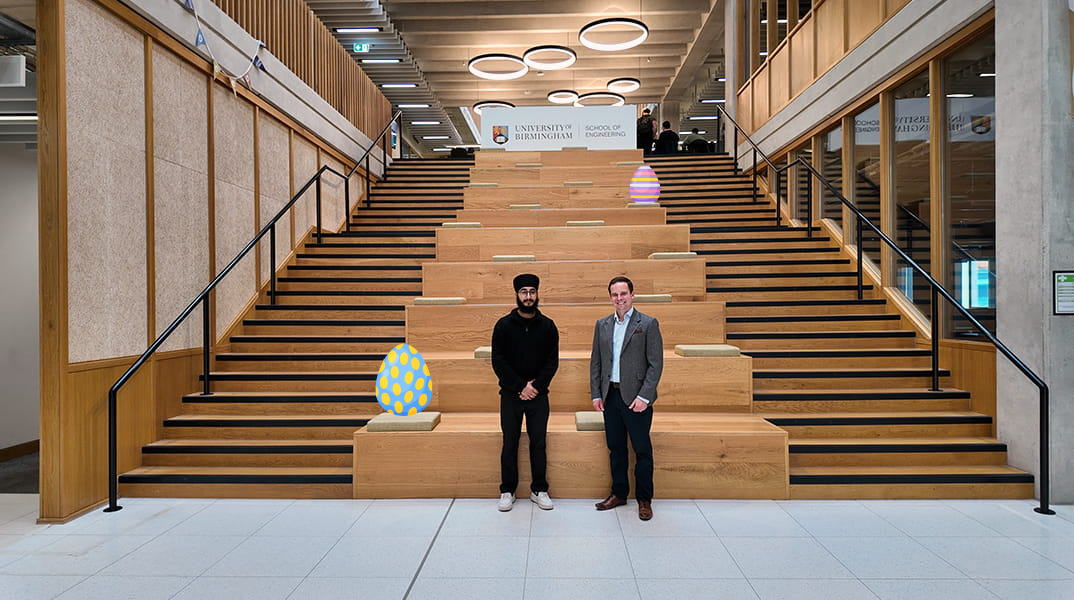
We spoke with Tom Osman (MEng Mechanical Engineering, 2004) and Diljit Singh, a fourth year MEng Mechanical Engineering student to see how the degree course has changed over the years and what remains the same.
Tom began his career at JCB, then went on to work with a design consultancy firm before starting his own consultancy which he ran for nine years. He is now Head of Design and Engineering at Shaily Innovations, which is the research division of a multinational medical device manufacturer. Diljit has secured a graduate project management role in property.
Old Joe: What do you think might have changed about the course since Tom studied here in 2004?
Tom Osman: Well, I might have a head start here in understanding a little about how the course looks now through my participation with the Industrial Advisory Board, which helps put an industry slant on what is taught within the course and making sure that students get valuable touchpoints with industry. We work to ensure that the skills that the students develop during their time here have relevance to industry once they join the workforce. There are a fair few alumni represented on the board, sharing their expertise from their own space within industry.
I’m not sure that industry preparedness was emphasised as much during my time here. But it's a different world, academia to industry, so a combined approach really helps elevate what is taught. I remember the occasional industry talk during my time studying. But now there's all the industry visits and guest lecturers coming in.
Diljit Singh: I've been on a couple of industry site visits. I think it gives you a great insight into what you can actually do. Back when I was younger, I went on an industry visit to Jaguar Land Rover and always thought I wanted to work with cars, be a mechanic or similar. But accessing a course like this, and going to visit different places, has opened my eyes to so many different routes. I've secured a graduate role that is nowhere near what I wanted to do when I was younger and I feel confident with where I'm heading, because I've learnt those skills here in Birmingham.
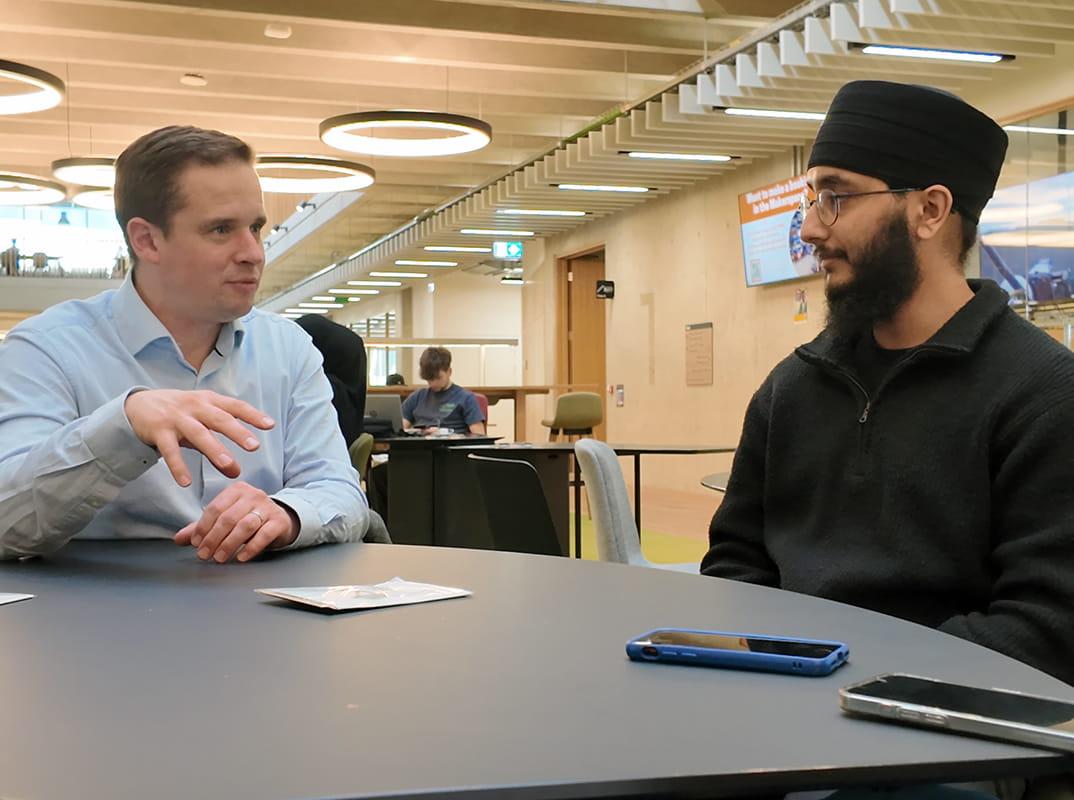
TO: Another obvious change is the building. There’s still the old engineering building, but the new engineering building has provided some exceptional facilities that have moved with the times as technology has evolved rapidly. There are a lot more hands-on opportunities. We are sat here outside the state-of-the-art Makerspace, which provides students with access to a range of manufacturing machinery and processes, 3D printing for example. It’s much more advanced than my days studying where we used more traditional equipment like pillar drills and milling machines.
For students overall, the access to information has undeniably been made quicker with mobile phones. There is this immediacy and global knowledge that students can just go and suck in and we didn't have that at all. The library was very much a central thing if you wanted to find anything out and the process was a little lengthier!
In my first year we learned on drawing boards and it took a very long time. If you drew something incorrectly, you would have to rub that bit out and draw it again.
OJ: What do you (or did you) enjoy the most about your degree?
DS: I like doing group work and I'm quite creative. I like coming up with the ideas, modelling and making designs, that's my favourite side of the course, especially with mechanical design.
TO: The thing that's really stuck (and we're talking, literally, half my life since I graduated) is the friends that I made on the course, we still talk, and we still meet up every year. We all came back to campus for a reunion a few years ago. And our kids all play together now.
DS: That resonates with me quite a lot. I’m involved in a lot at the University, I'm a student ambassador and I work at Aston Webb reception as well. The people you meet make up a big part of the university experience. I enjoy my course, but I think that social side you can’t really get anywhere else.
OJ: Were (or are) you in any societies?
TO: I was in the departmental band, Mike & The Mechanical Engineers, playing the rhythm guitar, it was probably a challenging listen, but we were free, so we played a lot of events.
DS: I'm in Sikh Soc, Power Lifting, Mountaineering and Olympic Weightlifting. I'm quite a curious person in terms of just trying new stuff.
OJ: Did you both do final year projects?
DS: For our final year projects we get over 200 different topics. You rank your top 10 and you get a supervisor. They're there to guide you but you are kind of by yourself. Did you do similar?
TO: Yes, we did a final year project, and it’s like the culmination of the course. You have a supervisor who acts like your boss but takes that little step back. So, you don't have so much freedom that you're going to fail, but if you want to do really well, you need to take that ownership and develop and drive that yourself. It's that first opportunity to focus into something you really like.
DS: It’s nice that it’s something of your own. Over your first three years you are kind of doing work that everyone else is doing. Whereas in the final year, you're doing your own thing. It's made me feel quite proud.
OJ: Tom, what advice would you give to someone, like Diljit, who's just about to graduate and enter the working world?
TO: On a personal level, make the absolute most of your time with your friends here, because that time that you get to see them and spend time with them won’t ever be as easy as it is now. On a professional level, be curious and solve problems. Be proactive in how you approach things and have the right attitude. There are a lot of people that have the right aptitude to do a job but not the right attitude.