And if so, how can we make sure it is both accurate and safe? Professor Alastair Denniston reviews what AI can offer in healthcare and how we manage it.
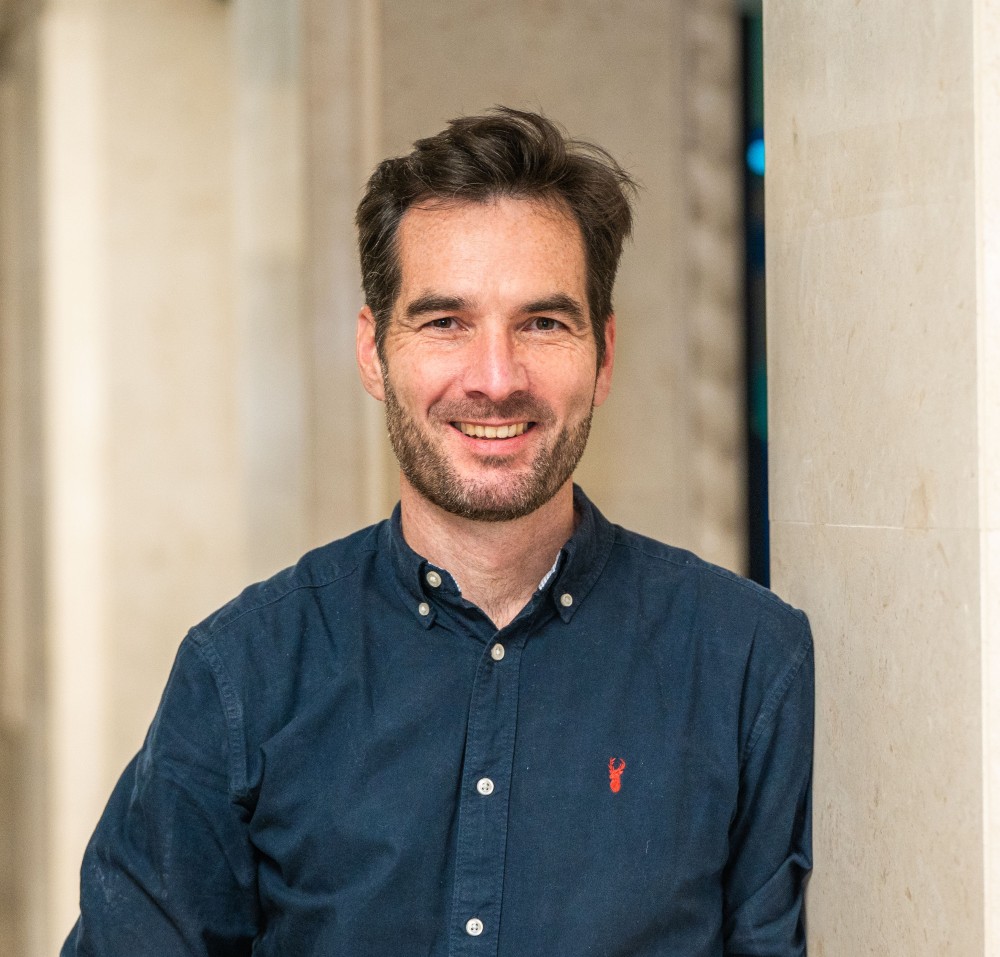 Alastair Denniston (PhD Immunology, 2009) teaches on the UK’s first taught MSc in AI Implementation here at the University of Birmingham. He is a Professor of Regulatory Science and Innovation, and a leader in the field of Artificial Intelligence (AI) and Digital Health Technologies. He has been chosen to chair a new NHS commission on AI in the NHS, which will advise on the first regulatory rulebook for the use of AI in healthcare.
Alastair says: ‘As a doctor in the NHS, I care about giving the best possible quality care to my patients. I want the fastest and most accurate diagnostic tests, and treatments that are as safe and effective as possible. Over the last 25 years, I've seen massive improvements in all those things. But there's still days when we see first-hand that our tests aren’t perfect and that our treatments have side effect and aren’t as effective as we’d like them to be. So, we are looking at how AI could help us take the next step in delivering better care for patients.’
1: Ways AI could be applied in healthcare
Getting more of your doctor’s attention
‘I’m regularly turning at my desk between the patient and my computer screen, tapping away at my keyboard. Frankly, that is not the best way to have a conversation about things you are really concerned about. What if an expert AI scribe could be taking those notes, so I can look you in the eye and talk to you like a normal human being? Hopefully you would get a better experience as a patient and feel really listened to. I then check the AI is accurate before I add it to your health record. That’s something that is already happening in many GP practices across the country.’
Bringing six months of data into a ten-minute appointment
‘Have you ever felt that your doctor’s appointment is at the "wrong time" – the symptoms that annoy you most days have suddenly vanished, but will reappear on your way home? These appointments are tiny snapshots in time, but these days you could bring in a living history of data which has been collected on your phone or a smartwatch to supplement what you say in person. No human doctor can assimilate this much information in a short appointment, but AI is very good at doing this. It can spot patterns in very large amounts of data. It’s up to you, but now you can share this information from these kinds of digital health trackers so that your doctor has both sets of information to help find the right diagnosis and treatment for you.’
Get instant second opinions
‘There are thousands of medical diseases out there. When you come to your appointment, I am running through all the possibilities, ranking them in likelihood. My questions, examinations and tests help us narrow in on a diagnosis. It's a skill we train for years in, but ultimately it is about learning patterns and connections. This is something that AI is really good at. There is a great opportunity to have AI working in the background, helping the human doctor in this process, and acting as a safety net to check we don’t miss anything. There are some things that we know patients want a human doctor for, but there is a lot that AI can help us with and be like an extra senior expert in the room.’
Quicker, more accurate test results
‘Speed matters in diagnosis. Some tests are slow because they depend on humans, for example checking X-ray scans for cancer, or retinal photographs for diabetic retinopathy. AI can provide near instant results for these scans and avoid the delays created by a relative scarcity of human experts. Obviously this is only useful when the AI is not only fast, but also accurate. Excitingly, there is an increasing number of diagnostic tests where AI is as good as humans, and that includes some forms of cancer detection or retinopathy detection. This means that you could get your results almost instantly and accelerate your path to treatment.
New treatments and more patient control
‘We're starting to use AI to help us design new treatments. The current drug development pipeline often takes more than a decade. I think we will see that kind of time halved by AI, and I think that will be amazing.
‘AI and the wider digital system of healthcare should also give patients more control of their healthcare, People will have much more choice and be able to make their own trade-offs as to what treatments they have. They’ll be able to get healthcare that is really personalised to them.’
2: Exploring whether and how to use AI
 ‘It is vital that those of us working in AI in healthcare continue to explore the safety of the systems we're using, and have open conversations with the wider public about what we want our future healthcare to look like. There will be massive positives like those I described above, but we also must understand any potential negatives so we can do something about them.
Choice
‘Our goal is to give people as much choice as possible on whether and how they engage with AI. There are some levels where that's easy, where you can opt in or out of sharing your data or having an AI scribe in your appointment. There are other things where it's harder, where it is a collective decision. For example, there was a time when we switched from having paper medical records to electronic health records. This was something that we had to do for everyone at the same time, as it would be unsafe to run two systems in parallel. In the same way, there may be some areas in healthcare where the AI is so much better than what we do now, that it just becomes standard for that particular role.
Bias in AI and representing everyone
‘AI reflects the data it is trained on. In healthcare, we have found that AI is often trained on datasets that are quite selective, and don’t reflect the full diversity of the population in which they are intended to be used. We call this health data poverty. We do a lot of work here at the University to map this problem and help innovators detect bias and then go on to create AI systems that are more inclusive and equitable. We have been working with UK regulators such as the MHRA to address this problem. We want everyone to have confidence that the AI systems that come into the NHS are effective, safe and inclusive. It’s not enough to be safe on average; we need AI to be safe for everyone.’
3: Asking what people really think about AI
‘What do you think about AI, and what role do you want it to have in your healthcare? We want to help people feel equipped to answer these questions, to help them know more about how AI could help and where it can’t, where there are opportunities and where there are risks. We don’t assume we know all the answers. This is not just a scientific question of what can technology do, but rather an important human choice of what we want it to do. It is about what do we want our future healthcare to look like.
‘One exciting development is that there is now a National Commission to look at this, in which we all have an opportunity to help shape the future of AI in healthcare through the role of regulation. As part of this, we are conducting surveys, face-to-face focus groups and a lot of discussion. We are trying to understand people’s concerns and to give people the information they might not have yet on such a new and varied form of technology. I’m honoured to have been asked to lead this Commission and am excited about the opportunity this represents for the NHS and the wider UK.’